

Gaza Strip: Sandstorms and killings exacerbate the suffering of displaced people
Ramallah, March 17, 2026
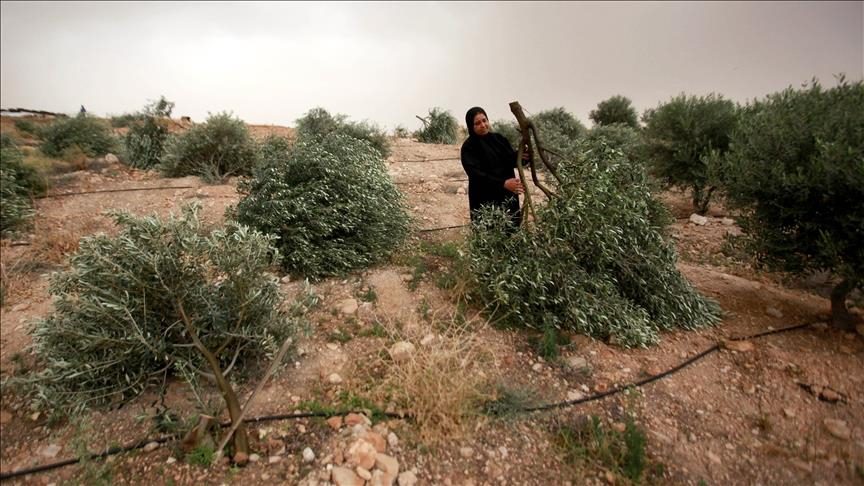
The OIC Media Observatory on Israeli Crimes Against Palestinians recorded unprecedented figures for the rate of Israeli occupation violations against agricultural lands in the West Bank, during the period between March 10 and 16, 2026. Occupation forces ordered Palestinian landowners to uproot fruit and forest trees on an area of more than 106,000 square meters in the lands of Ramallah, Jenin, and Salfit. They also bulldozed 120,000 square meters and uprooted hundreds of olive and forest trees in villages of Bethlehem and Ramallah, in addition to areas of agricultural land in Hebron, and uprooted thousands of trees.
The occupation forces confiscated 268,000 square meters of land belonging to Tubas and the town of Tammun. Settlement activities amounted to 11 in one week, and included the confiscation of tens of thousands of square meters belonging to the town of Arraba for military and settlement purposes, and 999 square meters of land from the town of Deir Istiya, to pave a road south of the village of Marda adjacent to the settlement of “Ariel”.
Settlers bulldozed agricultural land in the village of Jurish, near Nablus, leveling the land and cutting down and uprooting approximately 200 olive trees. They also bulldozed land in the village of Beit Iksa, near Jerusalem, and erected structures in preparation for establishing settlement outposts. They paved a road in the lands of the village of Al-Mughayyir, near Ramallah, and fenced off tens of thousands of square meters of grazing land near the village of Al-Aqaba, east of Tubas. They erected tents and sheep pens and seized a water well in preparation for establishing a new settlement outpost in Masafer Yatta. They erected a wooden structure on the lands of the village of As-Sawahra Ash-Sharqiya, near Jerusalem, and established a settlement outpost near a site they claimed was a Jewish site on Jabal Ebal, north of Nablus. Meanwhile, the occupation authorities carried out construction work to connect the Qalandiya checkpoint to Jerusalem with the bypass road near the village of Mikhmas, in the vicinity of the checkpoint. They also bulldozed agricultural land in the Al-Arbidat area, north of the town of Tuqu’, with the aim of completing a settlement road in Bethlehem.
The OIC Observatory recorded 122 murdered, distributed across the Gaza Strip and the West Bank. It documented the killing of 23 Palestinians in the Gaza Strip during the past seven days, in addition to the recovery of one body and the confirmed killing of 91 Palestinians, as well as 51 injured. In the West Bank, the OIC Observatory recorded killing of 7 Palestinians and 24 injured, bringing the total number of Palestinian fatalities between October 7, 2023, and March 16, 2026, to 73,175, with an additional 181,487 injured.
Israeli shelling targeted the town of Zawiya in the central Gaza Strip, Salah al-Din Street, Beit Lahia, the Shuja’iyya neighborhood, Khan Younis, and various areas of Gaza City. Gazans also recently faced a sandstorm that exacerbated the suffering of displaced people living in tents across the Gaza Strip.
In the West Bank, Israeli occupation forces continued to close the Al-Aqsa Mosque compound and forced shop owners to close their businesses after distributing free iftar meals to passersby.
In other West Bank governorates, Israeli forces demolished two houses, an agricultural room, and a stone-cutting workshop. They also occupied a house and converted it into a military barracks, re-erected mobile homes at a military site that had been evacuated years earlier near the town of Al-Auja, confiscated three vehicles and 35,000 shekels, destroyed water lines in Tubas, and seized gold jewelry from a Palestinian home.
Israeli forces arrested 175 Palestinians during 316 raids. Regarding attacks on children, the occupation forces killed two children and arrested seven others. They also detained a number of children in the village of Qiniya, near Ramallah, and injured five children. Settlers also assaulted a child shepherd in Jericho, and a settler ran over a girl in Hebron. They burned down a kindergarten.
In this context, settlers carried out 93 attacks including physical attacks on Palestinians. They also displaced 18 Bedouin families in the Shakara community near Nablus and the Khirbet Samra community near Tubas.
They released their livestock 15 times in the pastures and farms of Ramallah, Nablus, Hebron, and Tubas. They destroyed surveillance cameras in several villages, removed electricity meters, cut water lines in Tubas, cut down 200 olive trees in Nablus, and damaged olive tree branches in Bethlehem, Hebron, and Qalqilya. They burned olive trees in Ramallah, damaged greenhouses in Tubas, and burned a poultry farm, a storage shed, and a house with its furniture and a cart after displacing its residents in Masafer Yatta. Israeli settlers stole 500 sheep in Tubas and Nablus, a bus, solar-powered spotlights, and 35,000 shekels. They cut off electricity and water lines to the town of Deir Dibwan in Ramallah, tried to close a mosque in the villages of Nablus, and set fire to the Muhammad Fayyad Mosque in the village of Duma in Nablus after they stormed it and wrote racist phrases in Hebrew on its walls. The number of Israeli crimes over seven days reached 995, distributed across various Palestinian areas.