

Occupation Forces Raided the West Bank 330 Times and Arrested 237 People
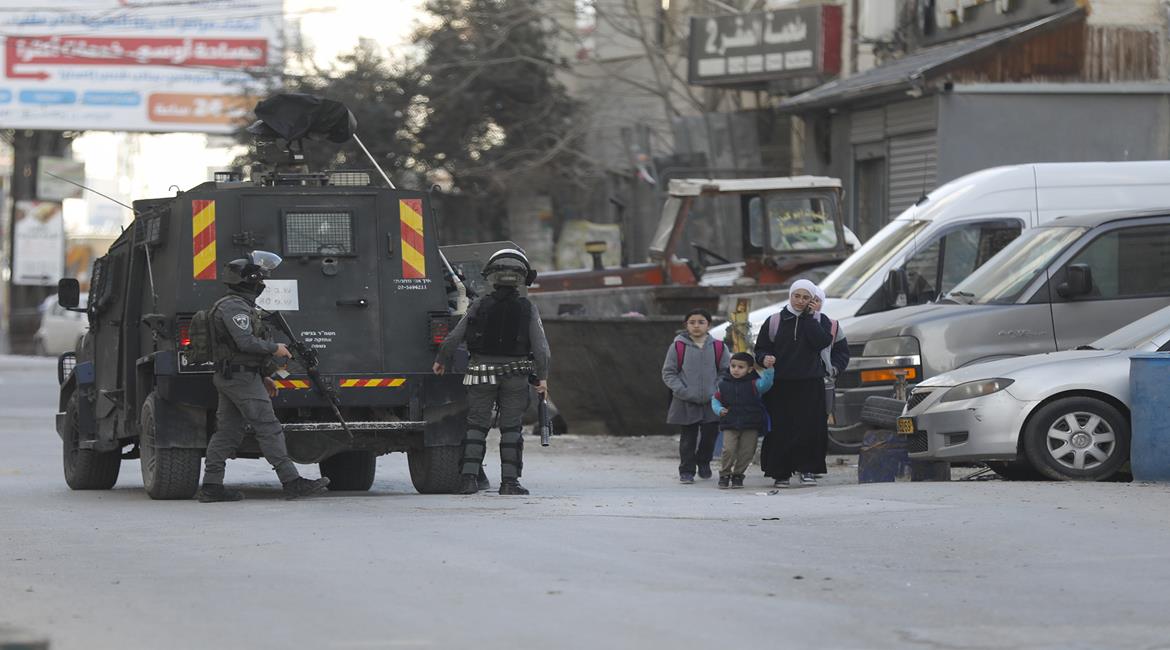
Israeli occupation forces raided the village of Aqab, and the OIC Observatory recorded 330 raids in the West Bank in one week. Photo from WAFA News Agency.
Ramallah, January 27, 2026
Israeli occupation forces continued their indiscriminate shelling of various areas in the Gaza Strip, in persistent defiance of the ceasefire agreement. The attacks, which targeted civilians between January 20 and 26, 2026, included shelling east of Deir al-Balah, al-Bureij refugee camp, al-Tuffah neighborhood, al-Mawasi, Khan Younis, Beit Lahia, and Gaza City, where four children were killed. Three journalists working with the Egyptian Media Center were also killed, bringing the total number of journalists killed by Israeli forces since the start of the war on the Gaza Strip to 260. Israeli forces also continued demolishing buildings in eastern Gaza, while two infants died from the extreme cold.
The OIC Media Observatory on Israeli Crimes Against Palestinians recorded a total of 111 killings and 85 injuries during the aforementioned period. The figures were distributed as follows: 21 killed were caused by direct fire from the occupation forces in the Gaza Strip, in addition to 58 injuries, 88 Palestinians whose killings were confirmed, and one body. The OIC Observatory also recorded one killing in the West Bank and 32 injuries. The total number of Palestinian killings during the period between October 7, 2023, and January 20, 2026, was (72,744), and (180,821) injuries.
In the West Bank, the number of incursions by the occupation forces reached 330 over one week, during which they demolished buildings belonging to the United Nations Relief and Works Agency for Palestine Refugees in the Near East (UNRWA) in the Sheikh Jarrah neighborhood of occupied Jerusalem. They also demolished 13 houses and 9 barns, occupied two houses and turned them into two military points, bulldozed agricultural land with an area of 20,000 square meters, uprooted 30 olive trees, imposed a curfew on the Jabal Johar neighborhood in Hebron for several days, arrested 237 Palestinians, including 11 children, and injured two children. Settlers also assaulted another child aged ten. The occupation forces stormed a secondary school in Turmus Ayya and detained its principal.
Regarding attacks on mosques, extremists brought in papers bearing Talmudic prayers during their storming of the courtyards of the blessed Al-Aqsa Mosque, at the behest of the extremist minister Itamar Ben-Gvir. The occupation forces closed the Ibrahimi Mosque in Hebron and expelled the worshippers, and settlers attacked the Sheikh Mosque in Nablus.
Thus, the number of settler attacks on Bedouin communities and Palestinian villages reached 83 in seven days. They forcibly displaced 15 families residing in the Shallah al-Auja Bedouin community in Jericho, following continuous attacks under the protection of the occupation forces, with the aim of seizing control of the area. The total number of families forcibly displaced from the community reached 94. Settlers also grazed livestock 19 times in most West Bank governorates within a single week, burned three bulldozers, two trucks, seven vehicles, land, and an agricultural pen, attacked the electricity network supplying a Bedouin community near Ramallah, destroyed homes and sheep pens, damaged solar panels and surveillance cameras, and confiscated some of them. They cut off water to more than 19 residential communities in the Ramallah area after damaging water pumping lines and obstructing repair crews. They stole vehicle repair equipment from a workshop in the northern Jordan Valley and cut down and uprooted trees. They threw olive branches several times in the vicinity of Nablus, and on four-wheel drive motorcycles they stormed the Iraqi Martyrs Cemetery in the village of Bir al-Basha in Jenin, and carried out provocative tours inside the perimeter of the cemetery.
In the same context, the number of settlement activities during the aforementioned period reached seven. During these activities, the occupation forces buried the dead in a settlement cemetery prepared on the lands of the town of Al-Zawiya in Salfit, after seizing approximately 180 dunams of the town’s land behind the separation wall. Settlers began constructing an outpost near the Bedouin community school in the Khan al-Ahmar area of Jerusalem. They also bulldozed land in the vicinity of Nablus and erected tents in preparation for establishing a new settlement outpost. Additionally, they erected a tent in the Jabal Johar area of Hebron after closing it off, as previously mentioned, in preparation for expanding an existing settlement outpost there. Occupation forces surrounded Palestinian land with barbed wire and prevented its owners from accessing it in the village of Beit Iksa in Jerusalem, after they confronted settlers led by the extremist Aryeh King, the occupation mayor of Jerusalem, following their attempt to seize the land. The occupation authorities continued their excavations beneath the Al-Aqsa Mosque, resulting in the collapse of a room inside a house adjacent to the excavation site, forcing three families to evacuate their homes. In the Silwan neighborhood, the occupation forces forcibly displaced a Palestinian family in the village of Atouf, in order to pave a settlement road on the village’s lands, bringing the total number of occupation crimes in the aforementioned period to 1,125 crimes of various categories.